Hardware architecture
The platform is divided into several components on PCBs. Different functions may be implemented on each PCB, but the interfaces should stay the same to keep them interoperable. These PCBs are illustrated in the figure below.
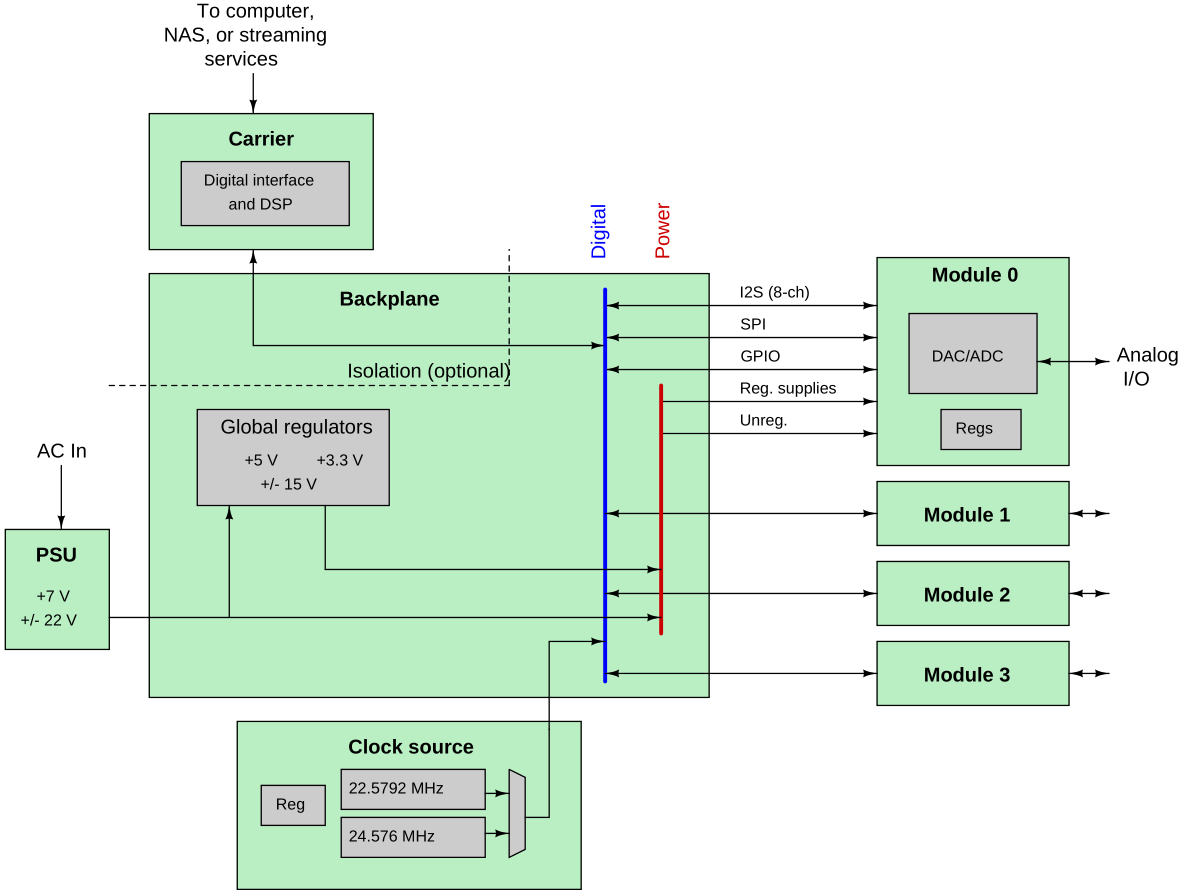
The following sections briefly describe the function of each PCB and their interfaces to the other PCBs.
Modules: An audio ADC or DAC. The basic requirement of a module is an I2S input (or output). The module interface provides for:
- Up to 4 lanes of I2S data (nominally 8 channels of audio)
- Regulated and unregulated power supplies
- SPI interface for software control of audio converters and other peripherals
- GPIO interface: 8 bits in and 8 bits out
If you design a new module complying to the module interface specification, you can write some high-level software to control it, but won’t have to change any of the other links in the chain.
Carrier: A digital source/sink for the signals that go to each module. Can include or interface to a computing device (whether embedded or separate) to improve flexibility. Carriers don’t necessarily have to support every possible feature.
Backplane: Interconnect between the carrier and the modules. Also distributes power from the PSU to the modules. The carrier can be powered by the same power supply as the modules, or have its own power supply. The backplane also contains supply regulators for any modules that don’t have local regulation.
Clock source: Supply of the necessary clocks for audio converters, at a nominal frequency of 22.5792 MHz or 24.576 MHz. Clocks are distributed differentially by the backplane. The clock source has separate output pins for 5 loads: one for each of the four modules, and one for the carrier.
PSU: An unregulated power supply. Generates separate +7 V rails for the digital and analog sections, and +/- 22 V rails for the analog sections of modules.
Boards designed so far
This section describes the features of the PCB designs that have been completed and tested so far. Eagle 5.x files for the boards can be found in the pcb directory.
Some modules were developed for an earlier version of the platform, and have been tested with the current version using an adapter PCB. These older modules would need to be revised to meet the current interface specification, and don’t fit within a reasonably sized chassis with the current backplane (because they are mounted vertically).
Modules
More detailed information about modules (explaining the design process) will be added later. For now, here is a short summary of what is on each board. The baseline implementations use AKM parts because they are readily available (with full datasheets), perform well, and the DACs conveniently have voltage outputs.
- DAC2 (2 channel DAC)
- DSD1792 (tested on earlier platform only)
- No local regulation; uses regulated supplies from backplane
- Two iterations of a common-base I/V stage
- Revision A with simple BJT current sources and MOSFET follower output
- Revision B with improved PSRR, 3rd-order antialising filter and diamond buffer output
- AK4490
- LT3042 local regulators for VDDL/R and VREFL/R; ADM7160 regulators for AVDD and DVDD
- AD9515 LVPECL clock receiver powered by ADM7154 regulator
- ADA4899-1 output buffer/filter powered by ADP7142/ADP7182 regulators
- 2 V differential (1 V single-ended) full-scale output
- 0/10/20/30 dB resistive attenuator controlled by GPIO
- DSD1792 (tested on earlier platform only)
ADC2 (2 channel ADC)
- AK5572
- LT3042 local regulators for AVDD and VREFL/R; ADM7160 regulator for DVDD
- AD9515 LVPECL clock receiver powered by ADM7154 regulator
- ADA4004-4 input buffer; ADA4932-2 ADC driver powered by ADP7142/ADP7182 regulators
- 2.25 V full-scale input (differential or single-ended)
- AK5572
DAC8 (8 channel DAC)
AD1934 (tested on earlier platform only)
No local regulation; uses regulated supplies from backplane
Two iterations of a voltage gain / antialiasing filter stage
-
- ADP7118 regulators for AVDD and VREF; ADM7160 regulator for DVDD
- LS90LV012 LVDS clock receiver powered by ADP7118 regulator
- OPA1664 output buffer/filter
- 2 V single-ended full-scale output (no differential output)
- 0/10/20 dB resistive attenuator controlled by SPI
ADC8 (8 channel ADC)
- AK5578
- ADP7118 regulators for AVDD and VREF; ADM7160 regulator for DVDD
- LS90LV012 LVDS clock receiver powered by ADP7118 regulator
- OPA1664 input buffer; THS4524 ADC driver
- 2.25 V full-scale input (differential or single-ended)
- AK5578
Clock source
Initial version with multiple stuffing options
- One clock is on and one is powered down at all times (selected by carrier)
- Damped ferrite bead supply filters leading to each oscillator and to logic
- Low cost stuffing example:
- ADM7160 regulator
- Epson SG-210STF oscillators
- 74xx CMOS mux and FIN10xx LVDS buffer
- High performance stuffing example:
- ADM7154 regulator
- Crystek CCHD-957 oscillators
- ADCLK948 LVPECL clock mux/buffer
Note that you can use any combination of oscillator, regulator and buffer. There are SMD footprints which would fit (for example) the NDK NZ2520SD, and DIP footprints that fit (for example) the Tentlabs XO.

Testing of a clock source board allowing comparison between Crystek CCHD-957 and Tent XO oscillators.
Backplane
- Initial version
- Stuffing options for digital interconnect:
- ADUM340x / ADUM14xE0 transformer isolators
- Resistor/jumper bypass option for non-isolated system
- Global regulation (+5 V, +3.3 V, +/- 15 V) with stuffing options:
- LM317/LM337 with Vadj bypass
- Jung regulators with LM317/LM337 preregulator
- Stuffing options for digital interconnect:
Carrier
Initial version contains:
ZTEX USB-FPGA 2.13a (Xilinx Artix-7 XC7A35T FPGA, 256 MB memory)
This project includes an HDL design and build scripts for the FPGA to function as the carrier, exercising all features of the module interface. It also acts as a deep (8M sample) asynchronous FIFO, since the USB interface clock is unrelated to the audio clocks. Much more information about this can be found in the Digital design section.
Raspberry Pi (optional)
I use MPD running on the Raspberry Pi as a streaming server for audio files stored on a NAS. The Raspberry Pi is mounted on the carrier card within the chassis, and has an extension cable to an Ethernet jack on the back. However, you can leave out the Raspberry Pi and connect any computing device to the FPGA board using USB (with a similar extension cable). It’s possible to use a USB Wi-fi adapter.
External 5 V DC wall wart supply (can be isolated from audio supplies, if backplane is equipped with isolators)
Debug/expansion header (0.1” pitch) for prototyping

Photo of carrier board stack showing ZTEX FPGA board (right) and Raspberry Pi (top) connected with a stacking header.
PSU
- Initial version
- 60 Hz linear supply with diode rectifiers
- Dual 5 V (Triad VPS10-2500) and 28 Vct (Triad FD7-28) transformers
- +7 V unregulated outputs for analog and digital sections
- +/- 22 V unregulated outputs for analog sections
- 10,000 uF decoupling for each rail
- At least 1 A load is allowed for all supplies simultaneously

Detail of transformer wiring for PSU. The rectifier/filter PCB is in the upper right.
Interfaces
This section describes the electrical interfaces in the initial version of the DA platform. The idea is that different PCBs can be designed for each function (carrier, backplane, modules, etc.) and safely interchanged if they meet the interface specifications. All of the board-to-board connections are made with standard 0.1” pitch headers. It’s possible to stack boards, or (except for modules) to put the boards side by side and make the connection with an appropriately sized ribbon cable.
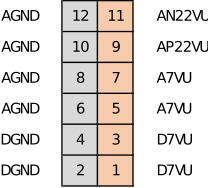
PSU to backplane : 12 pins (6x2 header)
In the baseline design, the PSU has transformers directly screwed to the chassis, and a small rectifier/filter board that mounts to the right of the backplane. They are connected via a ribbon cable.
| Pin number | Name | Description |
|---|---|---|
| 1 | D7VU | Unregulated +7 V for digital section |
| 2 | DGND | Digital ground |
| 3 | D7VU | Unregulated +7 V for digital section |
| 4 | DGND | Digital ground |
| 5 | A7VU | Unregulated +7 V for analog section |
| 6 | AGND | Analog ground |
| 7 | A7VU | Unregulated +7 V for analog section |
| 8 | AGND | Analog ground |
| 9 | AP22VU | Unregulated +22 V for analog section |
| 10 | AGND | Analog ground |
| 11 | AN22VU | Unregulated -22 V for analog section |
| 12 | AGND | Analog ground |
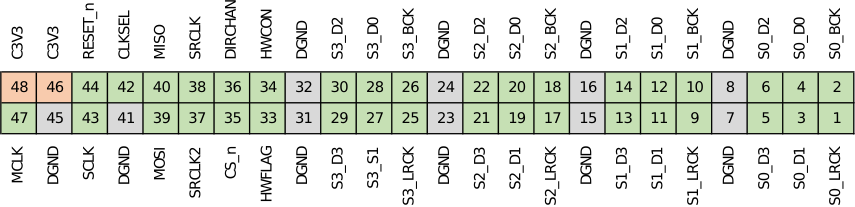
Carrier to backplane:
In the baseline design, the backplane has a female header on top, and the carrier has a male header on the bottom. The carrier stacks on top of the backplane.
| Pin number | Name | Description |
|---|---|---|
| 1 | S0_LRCK | I2S word clock for module slot 0 |
| 2 | S0_BCK | I2S bit clock for module slot 0 |
| 3 | S0_D1 | I2S data lane 1 for module slot 0 |
| 4 | S0_D0 | I2S data lane 0 for module slot 0 |
| 5 | S0_D3 | I2S data lane 3 for module slot 0 |
| 6 | S0_D2 | I2S data lane 2 for module slot 0 |
| 7 | DGND | Digital ground |
| 8 | DGND | Digital ground |
| 9 | S1_LRCK | I2S word clock for module slot 1 |
| 10 | S1_BCK | I2S bit clock for module slot 1 |
| 11 | S1_D1 | I2S data lane 1 for module slot 1 |
| 12 | S1_D0 | I2S data lane 0 for module slot 1 |
| 13 | S1_D3 | I2S data lane 3 for module slot 1 |
| 14 | S1_D2 | I2S data lane 2 for module slot 1 |
| 15 | DGND | Digital ground |
| 16 | DGND | Digital ground |
| 17 | S2_LRCK | I2S word clock for module slot 2 |
| 18 | S2_BCK | I2S bit clock for module slot 2 |
| 19 | S2_D1 | I2S data lane 1 for module slot 2 |
| 20 | S2_D0 | I2S data lane 0 for module slot 2 |
| 21 | S2_D3 | I2S data lane 3 for module slot 2 |
| 22 | S2_D2 | I2S data lane 2 for module slot 2 |
| 23 | DGND | Digital ground |
| 24 | DGND | Digital ground |
| 25 | S3_LRCK | I2S word clock for module slot 3 |
| 26 | S3_BCK | I2S bit clock for module slot 3 |
| 27 | S3_D1 | I2S data lane 1 for module slot 3 |
| 28 | S3_D0 | I2S data lane 0 for module slot 3 |
| 29 | S3_D3 | I2S data lane 3 for module slot 3 |
| 30 | S3_D2 | I2S data lane 2 for module slot 3 |
| 31 | DGND | Digital ground |
| 32 | DGND | Digital ground |
| 33 | HWFLAG | Serialized GPIO input from modules |
| 34 | HWCON | Serialized GPIO output to modules |
| 35 | CS_n | Serialized SPI chip select (active low) |
| 36 | DIRCHAN | Serialized module configuration indicator |
| 37 | SRCLK2 | 2nd level (64 bit) deserializer clock |
| 38 | SRCLK | 1st level (8 bit) deserializer clock |
| 39 | MOSI | SPI data output to modules |
| 40 | MISO | SPI data input from modules |
| 41 | DGND | Digital ground |
| 42 | CLKSEL | Clock select (e.g. 22.5792 vs. 24.576 MHz) |
| 43 | SCLK | SPI and serializer clock |
| 44 | RESET_n | Module reset (active low) |
| 45 | DGND | Digital ground |
| 46 | C3V3 | 3.3 V digital supply from carrier |
| 47 | MCLK | Audio clock for I2S masters |
| 48 | C3V3 | 3.3 V digital supply from carrier |
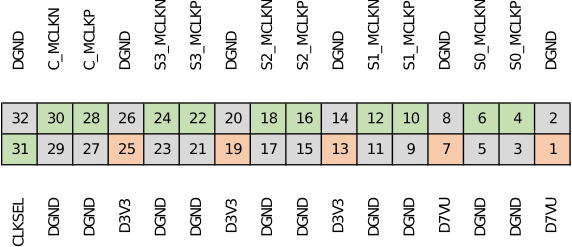
Clock source to backplane:
In the baseline design, the backplane has a female header on top, and the clock source has a male header on the bottom. The clock source stacks on top of the backplane, hanging over the lower edge.
| Pin number | Name | Description |
|---|---|---|
| 1 | D7VU | Unregulated 7 V supply |
| 2 | DGND | Ground |
| 3 | DGND | Ground |
| 4 | S0_MCLKP | Differential clock output to module slot 0 |
| 5 | DGND | Ground |
| 6 | S0_MCLKP | Differential clock output to module slot 0 |
| 7 | D7VU | Unregulated 7 V supply |
| 8 | DGND | Ground |
| 9 | DGND | Ground |
| 10 | S1_MCLKP | Differential clock output to module slot 1 |
| 11 | DGND | Ground |
| 12 | S1_MCLKP | Differential clock output to module slot 1 |
| 13 | D3V3 | Regulated 3.3 V supply |
| 14 | DGND | Ground |
| 15 | DGND | Ground |
| 16 | S2_MCLKP | Differential clock output to module slot 2 |
| 17 | DGND | Ground |
| 18 | S2_MCLKP | Differential clock output to module slot 2 |
| 19 | D3V3 | Regulated 3.3 V supply |
| 20 | DGND | Ground |
| 21 | DGND | Ground |
| 22 | S3_MCLKP | Differential clock output to module slot 3 |
| 23 | DGND | Ground |
| 24 | S3_MCLKP | Differential clock output to module slot 3 |
| 25 | D3V3 | Regulated 3.3 V supply |
| 26 | DGND | Ground |
| 27 | DGND | Ground |
| 28 | C_MCLKP | Differential clock output to carrier |
| 29 | DGND | Ground |
| 30 | C_MCLKP | Differential clock output to carrier |
| 31 | CLKSEL | Selects active oscillator (22.5792 or 24.576 MHz) |
| 32 | DGND | Ground |
Module to backplane : 54 pins (2x 27x1 header, with 2.0” spacing)
The module has some additional mechanical requirements because they sit on top of the backplane.
TODO: Drawing of mechanical footprint of module
If you can’t fit all the necessary circuitry on one board of this size, consider vertical stacking. You could also design an extra-wide module that takes up 2, 3, or 4 slots.

| Pin number | Name | Description |
|---|---|---|
| 1L | AP15V | Regulated +15 V supply for analog section |
| 2L | AGND | Analog ground |
| 3L | AGND | Analog ground |
| 4L | AN15V | Regulated -15 V supply for analog section |
| 5L | AGND | Analog ground |
| 6L | A5V | Regulated 5 V supply for analog section |
| 7L | D3V3 | Regulated 3.3 V supply for digital section |
| 8L | DGND | Digital ground |
| 9L | BCK | I2S bit clock |
| 10L | DGND | Digital ground |
| 11L | LRCK | I2S word clock |
| 12L | SDATA0 | I2S data lane 0 |
| 13L | SDATA1 | I2S data lane 1 |
| 14L | SDATA2 | I2S data lane 2 |
| 15L | SDATA3 | I2S data lane 3 |
| 16L | DGND | Digital ground |
| 17L | CS_n | SPI chip select (active low) |
| 18L | MOSI | SPI data input |
| 19L | MISO | SPI data output |
| 20L | DGND | Digital ground |
| 21L | D7VU | Unregulated 7 V supply for digital section |
| 22L | A7VU | Unregulated 7 V supply for analog section |
| 23L | AGND | Analog ground |
| 24L | AN22VU | Unregulated -22 V supply for analog section |
| 25L | AGND | Analog ground |
| 26L | AGND | Analog ground |
| 27L | AP22VU | Unregulated +22 V supply for analog section |
| Pin number | Name | Description |
|---|---|---|
| 1R | AP15V | Regulated +15 V supply for analog section |
| 2R | AGND | Analog ground |
| 3R | AGND | Analog ground |
| 4R | AN15V | Regulated -15 V supply for analog section |
| 5R | AGND | Analog ground |
| 6R | A5V | Regulated 5 V supply for analog section |
| 7R | D3V3 | Regulated 3.3 V supply for digital section |
| 8R | DGND | Digital ground |
| 9R | HWCON | Serialized GPIO input |
| 10R | HWFLAG | Serialized GPIO output |
| 11R | DIR | Module direction: 1 = DAC, 0 = ADC |
| 12R | CHAN | Number of channels: 1 = 8-ch, 0 = 2-ch |
| 13R | SCLK | SPI and serializer clock |
| 14R | SRCLK | 1st level deserializer clock |
| 15R | SRCLK2 | 2nd level deserializer clock |
| 16R | RESET_n | Reset (active low) |
| 17R | DGND | Digital ground |
| 18R | MCLKN | Differential audio clock input |
| 19R | MCLKP | Differential audio clock input |
| 20R | DGND | Digital ground |
| 21R | D7VU | Unregulated 7 V supply for digital section |
| 22R | A7VU | Unregulated 7 V supply for analog section |
| 23R | AGND | Analog ground |
| 24R | AN22VU | Unregulated -22 V supply for analog section |
| 25R | AGND | Analog ground |
| 26R | AGND | Analog ground |
| 27R | AP22VU | Unregulated +22 V supply for analog section |
Digital design
The baseline carrier design includes an FPGA, which gives it a lot of flexibility. This section describes the digital logic that runs on the FPGA, providing up to 32 channels of audio I/O through asynchronous FIFOs, and allowing a host computer to exercise all module features via USB.
The logic is defined in SystemVerilog hardware description language (HDL). Any future improvements will be shared with users who can simply reprogram their boards. The design could also be retargeted to other carrier boards. Please see the verilog directory of the repository for design and simulation sources, and the xilinx directory for build scripts.
I started out with the ZTEX USB-FPGA 2.13a board, which has all of the necessary features and comes with an elegant and open-source software/firmware stack for delivering data to and from the custom logic via USB. It is also affordable compared to other FPGA boards with similar capabilities.
The primary function of this design is to provide a bridge between a computing device and the physical interfaces (I2S, SPI, and GPIO) of the four DAC/ADC modules. (From a digital design perspective, it would be easy to change the number of modules at build time.) For now we are using a USB interface for the host computer, but other interfaces could be added in the future; for example, audio could be streamed over Ethernet, or control commands could be sent over a UART or SPI.
The architecture is shown in the following diagram.
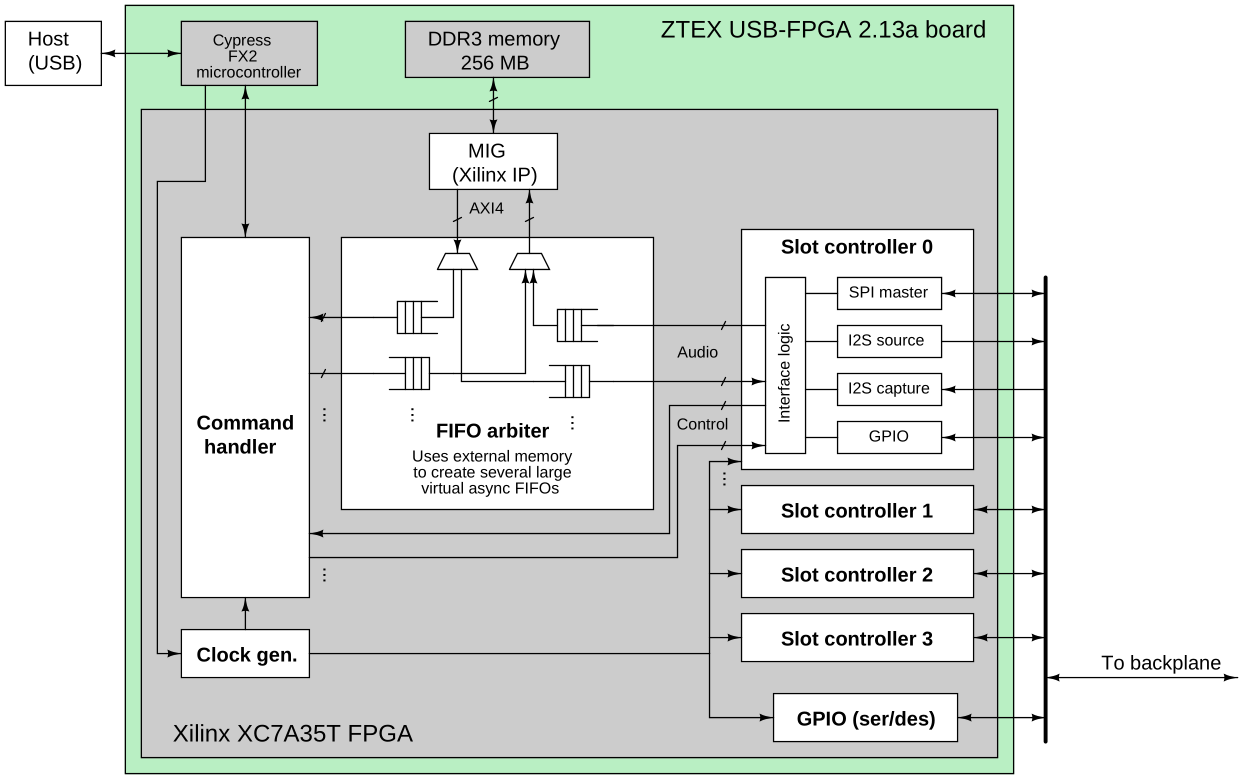
Each module interfaces with a “slot controller” which accepts commands and audio samples specific to that module. The audio sample I/Os are 32 bits wide and the stream of samples can be rearranged according to runtime configuration (number of channels, I2S vs. left-justified vs. right-justified, etc). The command interface is 8 bits wide; commands are encoded into a stream of bytes, with the first byte representing the type of command and the remaining bytes containing parameters/arguments.
Data sent over USB (broken into 16-bit words) is directed to the command handler, a state machine which examines each word and takes the appropriate action. There are some global commands which can be dealt with immediately by the command handler, for example the command to reset all of the modules. Other commands are addressed to a specific module and thus are delivered to the appropriate slot controller; the response is returned to the host.
Audio samples are handled differently: we want to provide a large buffer (FIFO) so the software on the host doesn’t need to keep up with the exact timing of playback or recording. A single buffer isn’t enough since there are four modules, each of which could be functioning as a DAC or ADC, or not being used at all. But with some massaging, we can use a single fast memory (DDR3) to provide a set of 8 virtual FIFOs (one in each direction for each module). Access to this external memory is controlled by a block called the FIFO arbiter. To the outside world, it looks like we have several independent FIFOs. On the ZTEX FPGA board, the DDR3 memory is 256 MB, so each virtual FIFO is big enough for 8M samples–more than a minute of stereo audio at 44.1 kHz.
There are three clock domains in the design.
- The USB interface provides a 48 MHz clock. The command handler and most of the control logic is driven by this clock; it is divided down to 3 MHz for SPI and GPIO signals.
- The DAC/ADC modules run on a clock that is a multiple of the audio sample rate. Nominally this is 22.5792 MHz or 24.576 MHz. This clock must have very low phase noise at the DAC or ADC itself, but the data signals to/from the carrier don’t need any special treatment as long as they meet the timing constraints of the chips they are talking to.
- The DDR3 memory runs on a faster clock (nominally 400 MHz). Interfacing to this memory is handled by a specialized IP block provided by the FPGA vendor.
Within the design, synchronizers and asynchronous FIFOs are used to transfer signals between different clock domains.